Showing posts with label Hierro. Show all posts

Thursday, 27 September 2007

The dangerous legacy of attacking football


A fascinating tactical analysis in today's El País uncovers some of the historical reasons for Real's defensive woes, typified in recent games by the squad's inability to maintain possession. This is aggravated by the fact that the midfielders do not push back to help defend and the central defenders stay too close to Casillas's goal. The Real Madrid technical team is trying to rectify the situation but "it is not easy because this squad is accustomed to have possession. When a team is constructed for attack, the players get out of the habit of also performing defensive duties."

Back in 1999, the then Real Madrid captain and central defender, Fernando Hierro (confirmed on Tuesday as the new sporting director of the Spanish FA and officially presented earlier today), perhaps conscious of the fact that his speed was not one of his best attributes, argued with the defensive midfielder of the day, Fernando Redondo, about how far back the central defenders should stay. With the arrival of Florentino's era and the emphasis on attacking galáctico signings, Hierro found an ally in Iván Helguera (not a particularly fast footballer either), who argued that "with so many players attacking, you have to be very coordinated at the back to push forward. If you leave too much space behind you, they can hurt you on the counter."

That worked fine when Real with Zidane owned the midfield and kept control of the ball, but three trophyless years brought Capello back to the Bernabéu and a renewed rigour to the squad's defensive duties. This was mostly accomplished by keeping defenders and midfielders in the Real half waiting for the opportunity to counter-attack. This also explains why Real Madrid had a much worse home than away record, given the fans' expectations when playing at the Bernabéu.

The new manager now finds that he has a problem. He wants to be able to play attacking football, but still be solid in defence. This poses problems for the midfield, who have far too much ground to cover, as the defenders play too close to Casillas. Diarra complains that "The space between defenders and midfielders is too great. When we lose the ball it is very hard to get it back."

Schuster's challenge is to convince his defenders that they can play further forward and not put additional pressure on Casillas to perform his usual heroics. Barcelona, who have been playing the same way for five years, have far better defensive statistics: Touré steals a ball every 12 minutes, compared with 18 minutes for Diarra. Similarly, Iniesta has better numbers than Guti, and Xavi is far more effective defensively than Sneijder. The transition won't be easy, if it happens at all, but it may go some way to explain the curse of the central defender which has plagued Real Madrid for years.

Continue reading this article »

Wednesday, 11 July 2007

The curse of the central defender

It seems a good time, given the recent addition to the squad of two central defenders: Pepe and Metzelder, to reflect on the 'curse' of the central defender at Real Madrid, particularly the non-native specimens.

It seems that first Sanchis, then Hierro, and now Helguera have been the only long-lived central defenders at Real Madrid in the last 15 years. They have two things in common: they all started as midfielders, moving back when their pace proved insufficient, and they are all Spaniards.

Some of those troubled by the 'curse', though still remembered fondly, were Alkorta (who had to move back to Bilbao for family reasons) and Karanka (a heart problem meant he was, in my opinion, unfairly overlooked in his last two seasons). Even hairy Iván Campo was an important contributor to Real's two Champions league wins in 2000 and 2002, although anxiety and depression fuelled by a hostile press and some in the club's management forced him to emigrate, with some success, to the Premiership.

But the 'curse' seems to reserve its malevolence for those that come from abroad, most of whom barely last a season or two before moving on:

  • Geremi (Cameroon) - signed from Turkish club Genclerbirligi in 1999, he made 45 appearances in 3 seasons (though in his last season he played only 9 times) before being loaned out to Middlesbrough in 2002 and sold to Chelsea in 2003 for 10 million euros. Solid if unexceptional.

  • Julio Cesar Santos (Brazil) - arrived in 1999 from Valladolid and played for one season. Loaned out in subsequent years until he was finally re-sold to Valladolid in 2003. Never fulfilled any promise he might have shown.

  • Walter Samuel (Argentina) - known as 'The Wall', he struggled to make a favourable impression in his only season at Real Madrid (2004-2005) and promptly returned to Italy with Inter.

  • Jonathan Woodgate (England) - Truly cursed: injuries denied him any kind of regular run and he only made 9 appearances in official games with Real between 2004 and 2006. Loaned out to Middlesbrough in 2006, the move was made permanent at the end of the season.

  • Fabio Cannavaro (Italy) - has struggled to live up to his 'FIFA World Player' title, even though Real Madrid ended up winning the league in his debut season. His future is currently uncertain and Juventus are thought to be lining up a bid to get him back.


One more curious fact: Gabriel Milito had a 'lucky' escape when his 2003 transfer to Real Madrid was suspiciously aborted on the pretext that he failed his medical, and that his knee injury had not fully healed. He went on to have an extremely successful four seasons at Zaragoza and today was unveiled as Barcelona's latest signing. You have to wonder how it might have turned out...

Continue reading this article »

Monday, 13 November 2006

Van the Man

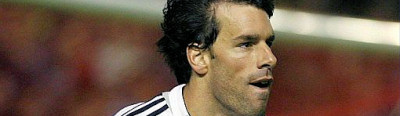
Ruud van Nistelrooy

The mercurial Dutchman made it six in a week by bagging all four of Real Madrid's goals at Osasuna's Reyno de Navarra stadium. Real Madrid has been missing a pure centre forward for some time (Ronaldo is not and has never been one) and if his current vein of form continues, there'll be many more goals for Ruud this season. There was some help from hapless defenders and goalkeeper, but the last of his goals, particularly, left even van Nistelrooy shaking his head in amazement as his curled shot sailed through the top right hand corner.

This is not the first time Ruud has scored four in the same game; he did the same for Manchester United in a Champions League game against Sparta Prague in 2004. The scoreline there was also 4-1. Real historians have to look back to club legend Di Stefano as the last player to score four goals in an away League match (against Las Palmas in 1957). The last time it happened in a home game was when Hierro netted four in Real's 7-0 thrashing of Espanyol in April 1992. Arguably the most famous 'poker' of goals was scored by Ferenc Puskas in the 1960 European Cup final where Real Madrid demolished Eintracht Frankfurt 7-3.

Games at Osasuna are always heated affairs, but things went too far when Iker Casillas was struck by a cigarette lighter and had to receive treatment. Given the Spanish football authorities' past record, I expect Osasuna will get away with little more than a slap on the wrist. Sad...

Continue reading this article »